Vénus de Lespugue
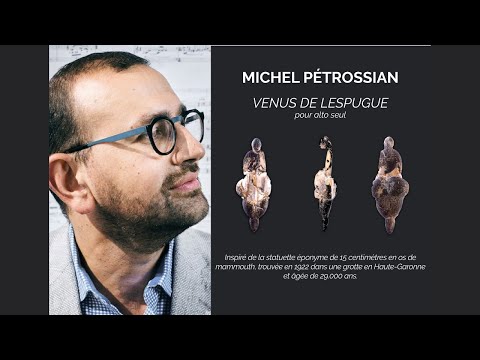
Venus of Lespugue takes its inspiration from the eponymous 15-centimetre statuette carved from mammoth ivory, discovered in 1922 in a cave in Haute-Garonne and dating back 29,000 years. It is one of the most fascinating objects of Prehistory and an emblem of the Musée de l’Homme in Paris, where it is displayed.
Beyond the evident beauty of the figure lies the ambiguity of its multiple form. The plurality of viewing angles offers several possible interpretations: a single woman or two—one giving birth to the other—or a female figurine combined with a phallic attribute, evoking the completeness of fertility. Whatever the interpretation, it would seem that the object was associated with a ritual function celebrating life in its renewal and continuity. I wished to remain as close as possible to the object of my inspiration—in order to soar as far as it carries us.
My approach oscillated between metaphysical inquiry and aesthetic wonder, between the musical transposition of the sculpture’s proportions and a very direct form of naturalism.
Thus, the work begins with a movement that recalls the story of its discovery.
The noisy diagonal bow strokes evoke the friction of the ground during the excavation, while the percussive sound produced simultaneously by the left hand recalls the blows of the pickaxe that uncovered this Venus while also disfiguring it (nine in number, referring to the nine fragments into which the statuette was broken at the moment of its discovery).
In an attempt at a poetic deciphering, I appropriated the idiom of the viola, seeking to create a kind of “world-work” that explores the instrument in all its avatars, yet guided by what appears to me as its very essence—the inner song.
This song is made up of pure sounds and complex noises, fragments of melody and strident rhythms. Fascinated by the figure of the circle that governs all the structural proportions of the object, I use the strings of the instrument as well as the wood of the body—particularly in bariolage passages that incorporate not only the strings but also the ribs of the instrument—as if to evoke the hypertrophied feminine attributes of this Venus, some of which are missing.
A play of detimbrated harmonic sounds may echo the primitive flutes that resonated in her time—sounds that take us beyond the limiting artifice of equal temperament.
An archaic song that is simultaneously a dance structures the second part of the work and requires particular agility from the violist, through the accumulative effect of multiplying voices—an homage to the plurality of interpretations—before previously heard elements return in a more concentrated and elliptical form.
My Venus of Lespugue is above all a tribute to the extraordinary longevity of the object and the permanence of its beauty through the centuries. By permuting the functions of time and space, I sought to verticalize this dizzying duration and respond in echo to the silence of millennia. For if the Venus of Lespugue has been contemporary with all the historical events we know, it has lived through twice as many periods about which we know nothing.
The piece is dedicated to Karine Lethiec, who not only commissioned and premiered it, but also did everything possible to sustain my interest and inspiration through her unwavering availability and knowledgeable enthusiasm, which allowed me to bring the work to a high degree of precision in its writing. Completed on the day of her birthday—and connected to the life impulse celebrated by the artisan of the Venus of Lespugue—the work is also dedicated to my son Darius.
Go to the publisher's website